
Measuring furniture for the route through your building
Measure furniture, doorways, turns, stairs and elevators before moving. Gather useful dimensions and photos for your mover to assess.
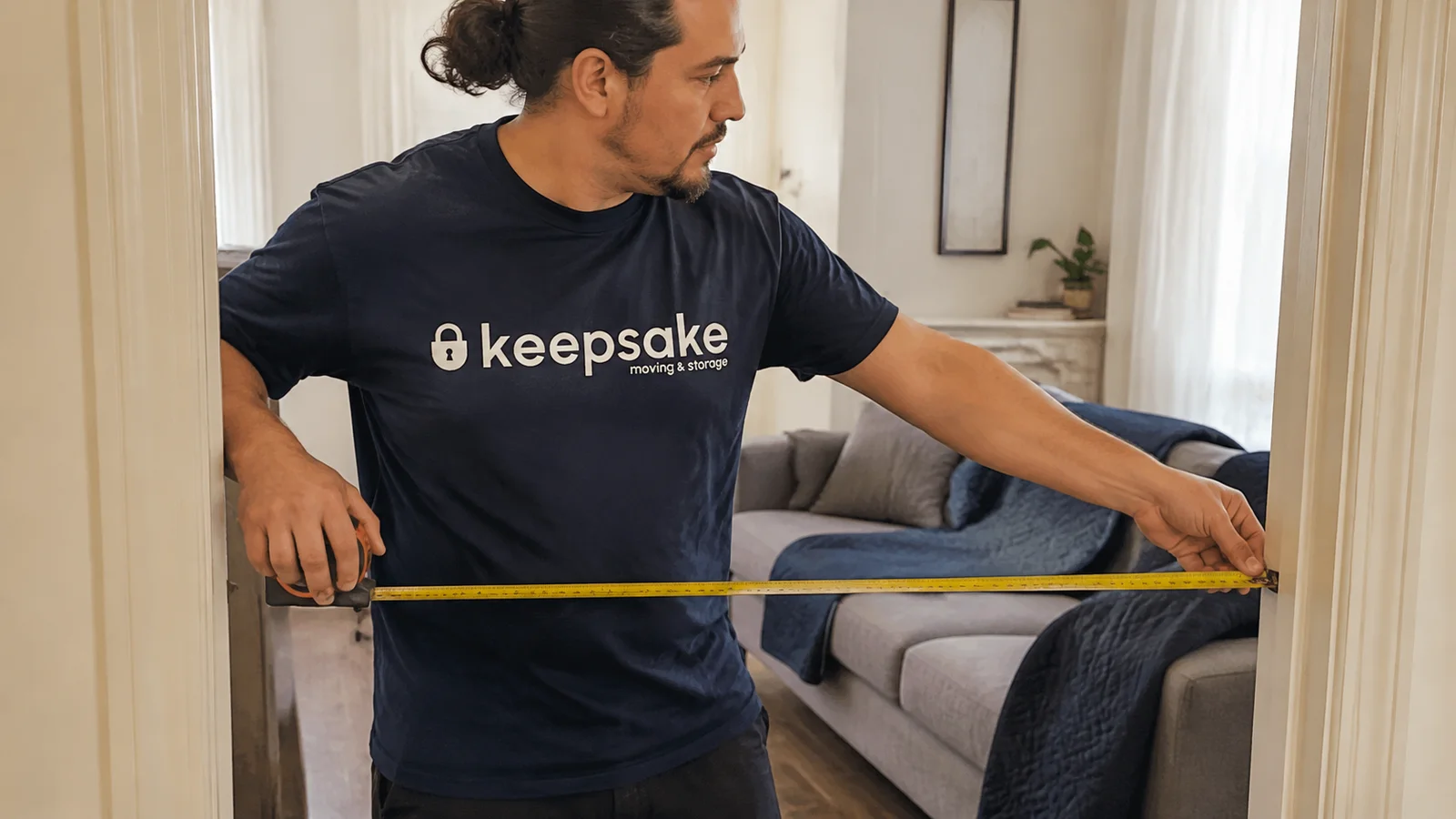
Before you start
Measure the furniture and the entire route through both properties, including turns and overhead clearance. A doorway wider than one side of a sofa does not prove the sofa can make the turn beyond it.
The sofa fits the new living room. That is encouraging, but it still has to get there. Before booking a move or agreeing to collect a secondhand piece, measure the furniture and the route between the street and its destination. The difficult point may be a turn well inside the building.
You are gathering information for a sensible decision, not proving that a piece will fit by one calculation. When the clearance is close, show the measurements and photographs to the people who will move it before anyone arrives to collect it.
Record the piece as it will actually travel
Measure the full width, height and depth, including arms, projecting feet, handles and any other parts that cannot stay behind. Use the same unit throughout your notes. A mixture of inches and approximate feet makes an already awkward comparison harder.
For a sectional, record every separate section. For a dining table, note the tabletop and base independently if the manufacturer confirms that they separate. Keep the product name, model number and assembly instructions where available. The dimensions in a sales listing may describe the assembled item, the packaging or a different size in the same range.
Do not assume the feet, arms or back can be removed. Identify what the instructions allow and ask whether the required disassembly and reassembly will be included in the moving work.
Walk the route before you measure it
Begin where the piece will leave its room and follow the route all the way outside. Repeat that process at the destination, working from the permitted entrance to the room receiving it. Include a service entrance, corridor or elevator if the building requires you to use it.
Make a short sequence in your notes, such as apartment doorway, corridor turn, elevator, lobby and exterior entrance. This helps a mover understand how the separate measurements connect. Send photographs in the same order, with a wider photograph showing each turn rather than only a close-up of the tape measure.
If the building offers more than one entrance, find out from management which route is permitted for the move.
Measure the narrow points and the space around them
Furniture retailer Room & Board’s delivery measuring guide checks doorways, hallways, stairs and elevator interiors, including obstructions that reduce usable space. Use that approach to collect the dimensions of the whole route.
| Part of the route | What to record | What a single measurement can miss |
|---|---|---|
| Doorway | Clear opening with the door in its permitted open position | A handle, closer or nearby wall reducing the turning space |
| Hallway | Usable width and the space at each corner | The length of the piece as it turns |
| Stairway | Clear width, overhead space and landing dimensions | A low ceiling at the turn or a wall facing the final step |
| Elevator | Door opening and usable interior dimensions | Handrails, ceiling features and the angle needed to enter |
| Final room | Available space and the approach from its doorway | Furniture already occupying the route into the room |
Measure around fixed features as they are. Do not remove handrails, interfere with fire doors or relocate building equipment to create a theoretical opening. Any proposed change to the property needs the right permission and people doing the work.
Treat a tight turn as a separate question
A long piece may pass through a doorway in one orientation and still have nowhere to turn. Similarly, a staircase can be wide enough while its landing is too short for the proposed maneuver. Record the space immediately before and after each obstruction.
Diagonal measurements can help describe available room, but they are not a universal fit test. Upholstery, shape, projections and the position of the people carrying the item all matter. Avoid telling a seller or mover that something “definitely fits” because one diagonal exceeds the item’s width.
If photographs leave the route unclear, a walkthrough is more useful than another page of guesses. Keepsake offers a free video or in-person survey. Flag the piece you are concerned about so the furniture and access can be reviewed together.
Compare both ends before agreeing to a pickup
A seller may have a ground-floor entrance while your destination has several landings. The fact that the furniture can leave their apartment says nothing about whether it can enter yours. If you are buying something, finish the destination checks before agreeing to a nonreturnable purchase or collection appointment.
Record the seller’s access hours and whether the item will be ready for collection in the agreed form. If it needs dismantling, decide who is doing that before pickup. Our secondhand furniture pickup guide covers the handover details beyond the measurements.
Send a useful measurement record
Put the information in one message or document so the recipient does not have to piece it together from several conversations. Include the item photographs, full dimensions, the access sequence at each address and a note beside anything that is still uncertain.
Keep original photographs as well as marked-up copies. A drawing can show the measurement while the photograph shows the handrail or ceiling feature that explains it. If access changes after the survey, such as building work closing an entrance, update the moving team before the date.
Leave a clear route on moving day
Measuring is only useful if the route remains available. Move loose shoes, plants and other household belongings out of the agreed path, while keeping shared hallways and exits clear. NYC’s fire-safety guidance specifically calls for unobstructed exits and access routes; the hallway is not a temporary storage area for the boxes you have moved aside.
For the piece itself, ask for help before attempting a difficult lift or turn. Our furniture moving service can review the item, photographs and access with you. A tight fit is something to assess before collection, while you still have choices.
Common questions
What size couch will fit through a 30 inch door?
Door width alone cannot answer that. Record the couch’s height, width and depth, the clear opening and the space on both sides of the doorway. Turns, ceiling height and removable components affect the assessment. Send the measurements and photographs of the whole route to the mover before committing to a pickup.
Should I measure furniture with the legs attached?
Record the assembled dimensions first. If the manufacturer permits removal of the legs or another component, note the dimensions of the resulting parts as well. Keep the instructions available and agree the disassembly work before moving day.
Which elevator measurements does the mover need?
Measure the clear door opening and the interior width, depth and height, then photograph the approach and the space outside the destination elevator. Include any turn immediately before or after the doors. The cabin dimensions alone leave out part of the carrying route.